Showing posts with label earthquake. Show all posts

Tuesday, 26 January 2016

Day 51 & 52: Christchurch

Monday 25th & Tuesday 26th January 

Christchurch was set up as an Anglican town on the marshes of the Canterbury plains. For a long while it was considered one of the most stable places in this earthquake prone country. Yet in 2011 a series of devastating earthquakes hit, along with aftershocks. After all these years Christchurch has gone from having to demolish all of its old, damaged, buildings and is working towards rebuilding.

Distance: Bus, 224km, walking, ~20km

Total Distance: 6019km

Getting out of Tekapo was somewhat easier than getting there, although some how I got the seat next to a guy who smelt of rotting chicken manure and decaying chicken corpses. Don't ask how I know what that smells like. Atleast I have a cold so I could only smell him through one nostril.

Arriving at Christchurch our driver dropped me just outside my hostel. It has been rated for many years as the best in the city, but made by the driver, speaking to the whole bus, made it sound far more sinister.
"My father once took me into Christchurch Jail. He was a warden there. Really creepy place. Spooky. Strange people. I wouldn't want to go in again."


I'm staying in Christchurch Correctional Facility! AKA Jailhouse Accommodation. The inside is lovely, white, clean and plain. Everything from staff tshirts, signs, bedspreads, and mugs are in the there of prisons- staff and signs are in jumpsuit orange, the rest being black and white striped. Three cells are maintained. The ground floor cell is filled with items from a standard cell, as well as a mannequin dressed as a warden. The cell above it contains artwork (graffiti) produced by the prisoners. Finally, at the far end of the building Solitary Confinement is kept, now embellished with cobwebs.

My room for the night


If you want age and spooky go to the prison in Napier, one of the first prisons in NZ and used for around 100 years. This one is much younger, and far less spooky. I enjoyed visiting Napier Prison, but not sure I would have stayed there. Christchurch, on the other hand, is one of the best hostels I've ever stayed in. It's well run, clean, friendly, the beds are great with a little shelf for a book and phone and 2 power sockets (some hostels are a nightmare for recharging equipment) . The toilets and showers have thankfully been upgraded since prison days (don't drop the soap!), as has the kitchen. 

Sorry, taken on phone when too dark...but look, prison mugs and table cloth!


Having performed an exorcism and the rites of Hades it was time to explore the city.
I quickly made for the train station. I'm leaving from here at 7:45am , so it's worth knowing where it is before a cold wet morning. From here I headed towards the museum, but wouldn't make it that day.
Firstly on my travels I hit the park and stumbled into the cricket oval, a site where they were clearing up from the weekend and where last year some of the Cricket World Cup was played. 
From here I went further and decided to take a short cut through the Botanic Gardens.

Hands down best Botanic Garden in New Zealand. 
I've been to a lot of them, nearly everywhere seems to have one. Dunedin's was lovely, but Christchurch was far better. The glass house is nearly the size to the one in Edinburgh, with smaller areas for rainforest, desert, marshland, and temperate displays. Outside is the large rose garden with each variety having its own bed, and surrounding borders including the large Dahlia border which was in full bloom.
Much of the garden is lawn and various trees, but also there are rockeries and native plant displays, a water garden, a long mixed border with plants from all over the world, a maple garden surrounded by Hydrangeas, and decorative plots by the road surrounding a painted fountain.
The visitor centre shows off how this is still a working botanical garden. Behind the cafe and shop stands a glass warehouse with rows upon rows of plants each in a pot ready for transport or to be transplanted. The area must be getting on for 200m by 50m, and that's just the nearly fully grown big stuff that they show off. 

View from the balcony in glass house


By this point it was 5pm so I had a quick wander to get a rough idea of where to start tomorrow, then went back to find milk for tea and Dominoes next to the jail for dinner. $5 for a pizza! I can't make a hot meal for that little (well, I can, but I like to pay myself minimum wage).

Next morning my first job was to find a library with computers so I could transfer my Canyon Swing photos from the USB stick to the Internet, then post the USB stick home. I grew up in Britain, I don't trust the post not to lose the parcel.
The useful thing about this excursion into non-tourist areas was that I could walk through the back streets of Christchurch, seeing normal life and what remains after the quakes.

In some areas they're having a complete revamp. Having torn out everything they're well on their way to getting shopping malls, multi-storey car parks, and offices built up to quake proof code. Many stretches of the street and pavements are fenced of as busy crews of skilled workmen, both local and European, work away or have tea breaks. 
On the other hand there are stretches where there's nothing but one wall and a stack of shipping containers. The area isn't very old, hence historical buildings might have stood for less than a century. Many of these buildings, if they didn't collapse, were condemned as unsafe. Yet the front face is a piece of local heritage. A dangerous piece.
Thus the buildings were demolished, but the front kept. Shipping containers (invented to enable the US military to transport supplies and vehicles during WWII, now used in their millions, celebrated for their simplicity and strength being entirely made of steel....I'll stop now)... Shipping containers are immensely strong, resilient, and relatively cheap so have been used extensively in the city. One use has been stacking them in front of old buildings. Stacks are about 6 high, with a stack of 3 on the roadside, held together with cables and attached to the building. Being so thick and strong this both protects the public in the event of a collapse, whilst maintaining the building.


Another use for shipping containers is the Re:Start Mall. 
Before I left the UK there was (another) flood that destroyed a towns shops in Yorkshire. The town set up a shopping centre made out of shipping containers. A rectangular enclosure was made of them, each containing a shop, with a gap for an entrance, an arch made by spanning 2 containers across the entrance. It was basic but worked well and everyone was happy enough. 
That's what I expected here. Something basic. Not what I found.
These are nolonger just shipping containers. They have glass fronts, proper doors, several containers joined together in a manner so you can't see the join. The interior looks like any other shop. There's even a container on the top of each with a sign for the shop it sits on. And everything's been painted in bright technicolour. Just looks like a create idea for a shopping mall, not an emergency measure to keep shops open. George Clarke would be proud.
(Check out George Clarke's Amazing Spaces, he sees as well as building some phenomenal things. He did a whole program on shipping containers, as well as people converting planes, boats, swimming pools, tree houses, trains, old buildings from the war.)
Most of your average shops are there, including the post shop, so there's now another wee parcel sent off to my parents.

Also, there were statues


Afterwards I visited the Cathedral. This was one of the oldest buildings in Christchurch, the city having been set up by staunch Anglicans, yet it was also one of the worst hit by the quakes, as were many of the city's churches. Stone edifices of 14th century design are not built to withstand an earthquake. 
This isn't the first time the cathedral has been damaged by a quake. 100 years ago the tip of the spire was broken off. Back then it was an annoying novelty. This time the damage is virtually irreparable.
Talking to wardens the parish wants a simple rebuild- even that totals over 60 million NZD though (£30m). Better that then the proposed rebuild by 'others' though (I didn't ask who the 'others' were. Not local parishioners by the way she said it.) would cost well over 200 million NZD (£100m) 
Either way the present site looks lamentable, waiting for a plan, whilst getting overgrown with weeds.


There is a shiny new cathedral though, and it's the largest building in the Southern Hemisphere made primarily out of cardboard! Had to go see it.
Imagine this. 12 shipping containers lined up in 2 rows, parallel, 12 yards apart. 6 tubes about half a yard in diameter and 4 yards in length, made out of a type of card board, are then placed into an arch, 3 forming each side. Repeat 98 times. Then put interlocking tough clear plastic over the outside. Add a wall at one end, doors at the other, and above the doors glass painted with images from the Windows of the old cathedral. And that's roughly what they built, helped by German engineering. 
It's an impressive structure with lots of additional features they are very proud of. The containers are all used for offices. The doors at the back can be completely opened out, useful when the place is packed out. There's a side chapel with a cardboard tube screen that opens out for use, or is closed to conceal during larger services. The enormous English oak lectern, altar pieces and Cathedra (that's the Bishop's big chair) were all rescued from the cathedral by a quake rescue team (after they'd saved as many people as they ever could).
It's all very impressive. I'm always impressed by the older churches here, in Europe we spent generations getting them up. Here, on the South Island, they did their best to build replicas in a few years, and many have lasted. Buildings of such complexity, weight, and size are increasingly difficult to build for us today- even here, such as in Dunedin, a hundred years ago people ended up taking short cuts due to time and money.
The temporary cathedral was one of the first buildings erected after the initial quake- they were finishing as the second quake and aftershocks hit. Yet they had congregations packing the place after each event, giving the local people the support and community they needed.


Time to finally hit the museum- mostly just a quick run through though.
First to the cafe though as it was 2pm and I hadn't eaten since I'd found a place that did chips and gravy that morning. Nothing to remind me of trips to York livestock market with my parents as a child like chips and gravy.
At the museum I found the cafe.
"Good afternoon, Sir, how are you today?", asked a very cheerful waitress. I had to stifle a laugh as I thought of Homer Simpson: "For once someone will call me 'Sir', without adding 'you're making a scene'"
I got some tea and was given a decent sized slice of date and honey cake, warmed up, smothered in butter. Yum. I do deserve the calories, honest. A read, a wee nap, and back on it.

The museum is huge. They even have an Allosaurus, plus an Edmontosaurus skull, Triceratops skull, and sauropod forelimb! 
Christchurch being the starting point for many Antarctic expeditions there's a big display showing their history, including much of the equipment they took, from clothes to exploring vehicles, such as the first tractor onto Antactica. A fine collection of stuffed animals too, both Antarctic and from New Zealand. 
There's the usual displays about Moari and Pakeha settlement, history, and culture, though larger than many.
There was an art exhibit of Jeff Thomson, showcasing his work and his talent. He works with corrugated steel, building everything from life sized giraffes, pigs, hens, dogs, and even a car, to bouquets and miniature houses.
Finally, my favourite, but not a fixture, Leonardo Di Vinci! A special exhibition showing his notes including, importantly, working models of his drawings! Well, working as in many could move. The flying machines still weren't going to fly, not the "robot" walk, but the ideas were all there. Flying machines, pulley systems, gearing ratios, pumps, levers, war machines, bridges, robots, musical instruments, ball bearings, ways to measure time. There were also a few of his paintings and a video about his life. 
Oh, and body bits. Well, very detailed models of bodies. Di Vinci, as an artist, and then as an engineer-scientist did a lot of research into anatomy. It was important as part of Renaissance art for students to understand the human form so as to draw and paint bodies appropriately. He went further however, looking beyond the superficial right down to the cranial nerves and the action of the heart. He did much that was against the doctrine of the church, which would eventually helped us all.

I left through the mock up of a Christchurch street from a hundred years ago...which was basically York as it is today, but with less neon.


Monday, 18 May 2015

Napier: The Art Deco Capital of the World

Hello again. Little late, busy weekend on call, let's talk about something better...

Last weekend was a mixture of architecture, aquatic life, art, and AAARGH! Its a GHOST!

I've been South, North, even more North, and West, of Bulls, hence last weekend was the time to finally go East. Out beyond the mountain ranges of the Ruahine and Tararua lies the rolling fields and long beaches of the Hawke's Bay region. Here, due to the wind breaking mountains to the west and the closeness of the sea, the weather is often more kind than much of New Zealand. If the Kiwi's everywhere else are having a bad spot of weather you can bet Hawke's Bay is doing that bit better. This gives the region two great attractions. 1, the long, sandy beach of the bay, enjoyed by many for all those beachy activities people who like beaches do. And 2, the vineyards- miles & miles of booze making branches adorn the land, occasionally interrupted by crazy people growing things like apples and pears (or maybe they're planning on making cider, which is much more sensible.).

I will now disappoint you all by telling you I went to neither of these places. I've added taking in one or more boozy bike trails to the "must do"list though- much more sensible than driving between them. Having been in all directions now I actually have quite a few ideas of places and activities for anyone planning to visit. So, if you want to escape the freezing cold of another mundane New Year & January (or are feeling adventurous enough to try a bizarre hot Christmas) book your tickets NOW!

I decided to go to the major destination in the east, that of Napier. This is a major port city, which initially had a large natural harbour and serviced the initial move by the Empire to colonise NZ. The city still is a major port, but there were significant changes to the city in 1931. The museum has a small but detailed exhibition about the earthquake which devastated the original settlement. I find it hard to comprehend what actually occurred. A quake of over 7 on the Richter Scale hit in the middle of the morning. It obliterated all the buildings made of stone and concrete, other than the prison wall, killing hundreds of people and injuring many more. Not only that but the land itself moved. The natural shallow, inland harbour floor rose up and is now grass land for feeding cattle. THE LAND LIFTED. The area that moved is about the size of central Edinburgh. And it just CAME OUT OF THE SEA. Boats and fish got left behind. Tons of fish left to suffocate and rot, creating and unbearable stench.

Everyone was moved out of the city and put into camps, using equipment supplied by the army to live during the clean up and reconstruction. The last remnants of buildings were demolished, then picked up and carted away. The army helped, but it was mostly the original inhabitants of these buildings who helped in this slow removal of their home town.

Eventually those who had stayed were able to begin rebuilding the city. The NZ government gave over the equivalent of a billion NZD (1/2 billion GBP), all the money it could spare at the time, to rebuilding. Specialist architects were brought in to design a new city. And that's what they did.

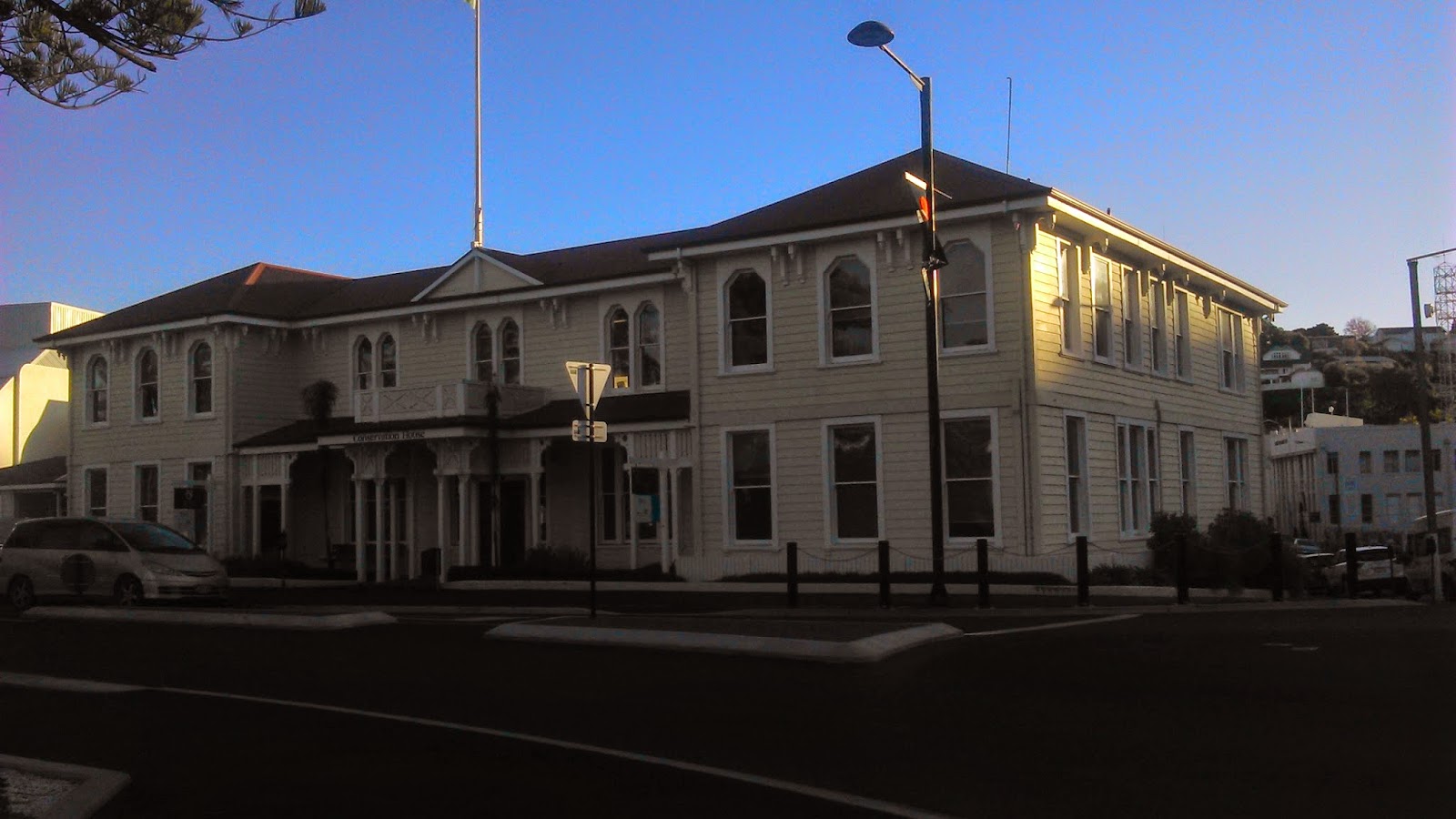
So it stands today, a concrete monument to the theme of 1920s & 1930s design. Nearly every building is in the Art Deco style. These are a couple of snaps I took, but you will find many more (and much better) by Googling for Napier and Art Deco


New Zealand's National Aquarium

Glass tanks filled with dark water aren't the best for photography, so I'll try give you a brief round up about the aquatic life I saw.

Due to the conservation work that goes on in NZ any native animals seen in captivity generally are in some way compromised for handling the dangers of the uncivilized world. This can be due to injuries from dogs, fishermen, hunters, or cars, as well as many other sources. Alternatively they may have been hand reared and so not have the skills to go wild. And so this sad turn of events is why the penguins all have missing parts.


There was also this beauty, a large sea turtle, with a shell the size of a fat man's torso.

There were also 8ft eels, 2ft cray fish, sharks, rays, star fish, angel fish, piranhas, conga eels, and lung fish.

There were also Tuataras, a form of endangered lizard only found in New Zealand. They are "living fossils" looking very much like lizard fossils found dating from a time before the dinosaurs. They are primitive, but how much they are truly a like to those ancient ancestors is something of a debate. Surely in some way they adapted to island life? How much has that changed them compared to those original lizards? One of the things I find fascinating is their ability, as adults, to change size. In times of drought they can reduce their size (right down to the size of their bones) by 20%, enabling them to survive on a reduced diet, before regrowing in better times.

There was also a Kiwi! Hidden in a dark room, behind sound proof glass, the fluffy football wandered round on cautious legs slowly sticking its nose in the leaf litter hunting for grubs. QI fans will remember that Kiwis have, scientifically, the shortest beak of any bird. This is because the science community measures beaks from the nostrils to the tip. Kiwis' have their nostrils at the tip of their "beak"such that they can shove it into things and hunt for insects by smell and sensing movement. It is some what unusual for a bird to have such a good sense of smell, most relying on their exceptional eyes, but Kiwis are nocturnal. Basically their an avian badger, without the TB, the screaming, or the ability to breed quickly. They run part of the breeding program from the Aquarium, hence this breeding female was on display there. Sorry, too dark for photos, but here's a nice chocolate Kiwi.


But my FAVOURITE animal goes to the RED GURNARD.

It WALKS! With 6 little tentacle-legs from near its gills it walks along the bottom of the sea/tank. It also has beautiful colouration on its pectoral fins, giving it the appearance of a butterfly.

Here's a link to a video of one walking: 
And some pics:

Also, outside the Aquarium, the nearby drains had these paintings around them proclaiming "Poison the Sea Poison Me!" Which looked amazing.


Now comes the part you've all be waiting for!

HM Prison Napier, wall and gate built in 1906 after the site had been used for a time as an army barracks.

In the 1800s the British Empire in NZ decided it needed somewhere to confine all the terrible people that happened to live in its borders. You know, the poor, the hungry, the mentally unstable, the newly arrived to this wee island. Those sort of terrible people.

So they built HM Napier Prison.

In its earliest days people were sent here for many reasons. There are letters from British relatives of people who were mentally unstable, asking to pay for their loved ones to be sent half way across the world to be kept under lock & key away from prying eyes. Others were here an immigrants, going through quarantine before being allowed into NZ proper. People were here because they were poor, as debtors. People could be sentenced to prison for only a few days if their crimes were minor, such as drunkenness and minor theft. 
And prison in those days was not as liberal as it has become today. No Human Rights act back then.
No Talking. No Laughing. No Singing. No Loud Noises. No Exercise.
3 to a 2-man cell. Doors shut at night, with only a 6 inch by 3 inch window for ventilation.
Doors open during the day, but no leaving your cell except for meal times.
Rations of bread and water, maybe more if you were doing hard labour.

These rules changed when prisoners started to get sick from malnutrition. 

Yet there were also, still, those people who they decided didn't deserve even these conditions.
A man who murdered his young children and wife after dreaming that they would die in a fire.
The man who took vengeance for the murder of his family by killing the murderer, then ate the eyes of his victim, as they contained the souls of his loved ones.
The pedophile who killed a young girl then evaded capture for decades. (he had to have his own exercise area, as otherwise the fellow inmates beat him.)

These terrible humans, and many more are buried in the small cemetery at the back of the prison. They are buried standing up, so that in death they can never have rest. Which would explain all the hauntings, and the including this sign being above the entrance to the area around the grave sight.


The Cultural Reasons are the belief that poltogeists formed by the spirits of the undead can possess the unborn and young children, living out their life once more, working to finish all that which they have not achieved in their own mortal life.

This has happened before, relatively recently.

A family came to the prison as tourists. After the visit the families young son started acting strangely, outside of his normal character. So, after 2 weeks, the family returned to the prison, with a priest, to exorcise the child, and he was back to normal there after. 

There are also stories of different people who stayed having dreams (or hallucinations) of a heavy weight on their chest, like someone sitting on them, and feeling a knife against their throat. Numerous times strange figures have been seen. The 8 foot dark figure that looked like a man walking one of the wings at night. The man who haunts the cell he spent his last night in prior to his execution on the anniversary of his death. (No one is allowed to stay in that room on that annual night any more.) Spheres of light that appear in photos taken inside the prison grounds. Spirits that a British traveller would sit on his bed and talk to every night. And the cat. Always the cat that appears near any of these supernatural occurrences.  The cat that has half a mustache, just like the last man to be executed at the prison.

Not only all of these stories, but inmates have left evidence of them in the mundane dimension too. The first cells I visited on the tour were those used for solitary confinement and for insane inmates. In side where all manner of messages and marks, including swastikas.

Three cells were designated "suicide watch", though this didn't stop many prisoners trying and managing to end their lives, using the easily exposed electrical wiring, or strangling themselves using springs from their beds. Their suicide notes are still visible, drawn or carved into the walls.

There are displays of gang art in a few cells. Prisoners from the 1950s onwards would write and draw on the sheets of MDF that made up their beds, covering the art with their mattresses. Gang signs are in abundance, as well as messages of hate. Many show the symbol of the "Mongrel Mob", a British bull dog wearing a Nazi SS helmet, often with a swastika. There had also been Black Power art, a black fist held in the Black Power- but this had been drawn over to create a pig's hoof. The Mongrel Mob seem to have made up the majority of inmates in the late 20th century, committing multiple horrific crimes both inside and outside prison.

I hope you can appreciate why I didn't feel like taking many pictures of the site. Prisons which once held the poor, the mad, and the hungry seem interesting and tame. In those days the worst of humanity was strung up as soon as they were convicted. Yet this prison carried on after those times, to hold those truly lost to society and civilisation. One just doesn't feel like ever remembering the efforts of  evil men when standing where they stood, reading what they thought, hearing what hate filled things they did. But that's no reason not to remember and hope that we can improve as a society. The gangs mentioned on the beds of inmates still exist today. They claim to have changed, improved, be working for their communities on charity projects and aid. I can't tell you if any of this is true, I can only hope it is.


The prison was closed in the 1980s, as the facilities grew substandard for the modern world. The prison was sold to private investors. Since then it has been used as a site for a local Alcoholics Anonymous group... until scary stuff happened. A hostel for backpackers wanting to stay in the cells and have spooky unhinging nights... until scary stuff happened (and many people have run screaming from their beds in the middle of the night). And now its a tourist destination. There are still people living here, staying a "minimum" of three months (if they last that long) working as tour guides and one the once a month late night scare show. A few of these have seen "ghosts" experienced strange goings on.

PS, for anyone wondering, during the 1931 Earthquake the prison, with most of the buildings made out of wood, fared very well. The floors are still buckled and broken after the event, which led to guards having to chop down walls as doors became jammed in the altered floor. These prisoners then helped in gangs to clear and rebuild the city. They also helped to build this wee park, from what was once a quarry they worked as part of their Hard Labour detail.


Finally I'll add some last few pictures of a few other places I went to.
Napier has a model railway museum! So just had to go there.
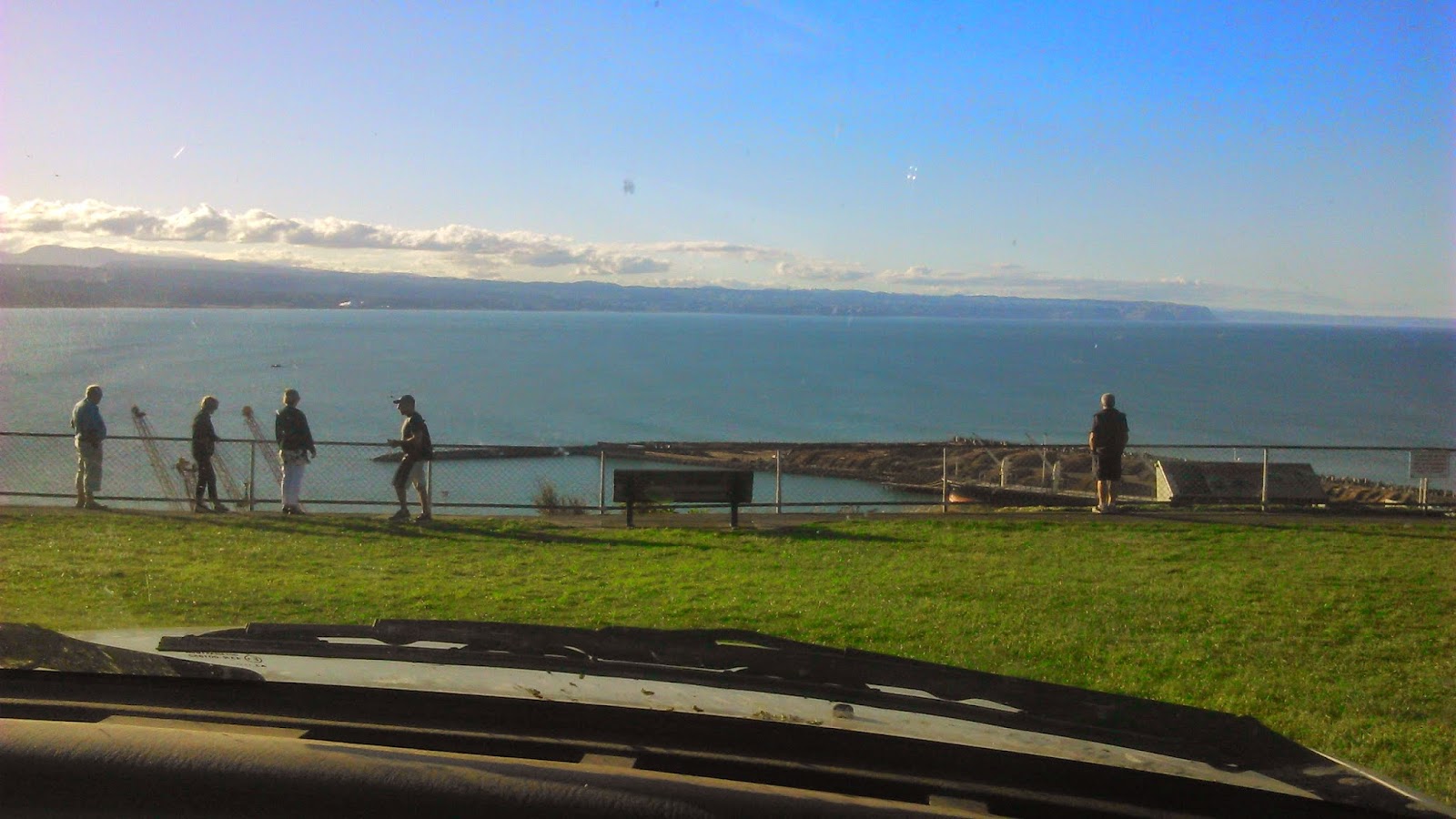
And Bluff Hill look out point, which was once housed 2 artillery pieces, and now lets tourists look over Hawke's Bay and the modern harbour.


Can you tell which one's are from the real life harbour?


A fountain funded by a Mr Parker


And Parker's Chambers

Both of which I'm sure my mother's side of the family (The Parkers) will find interesting  


I stayed in an old stable building, converted into a hostel