Showing posts with label prison. Show all posts

Monday, 28 March 2016

Day 106: Port Arthur prison to Hobart

Saturday 20th March

Port Arthur prison
Richmond the historic farm town

Distance:
Total Distance:

Having spent the night in what was an excessive house for four people, next to a field of wallabies and a cemetery, we went to go pick up the others. 
With them on board all seven of us handed off for a couple of local seaside look outs. 
At the coast we visited Remarkable Cave. To get to the look out platform for this one we had to climb down several flights of stairs to get level with the cave. In reality it's more of an extended arch- we stood above the sand and looked out onto the sea beyond. One of the remarkable things about the cave is that when you look through it the space through it looks like the out line of Tasmania!
There were also a collection of bones on a boulder behind us. My professional opinion is that these were Wombat bones. Probably an animal that had fallen through the foliage and down the cliff. Wonder who put them up on the boulder though, so that the wombat stared at every passing visitor?
Next to this was also stopped at Maingon Lookout- more beautiful cliffs, more clean sea water.

The big event of the day was Port Arthur- "Australia's Best Known Penal Colony". And there was me thinking it was Sydney.
In the early 1800's we were filling Australia with people who stole bread to feed their families or £1 handkerchiefs from men worth thousands. Some of these made it to Hobart, but so had many civilised people. With the growing number of prisoners there were complaints from the free people. Thus Port Arthur was built. The peninsula is nearly an island, with an isthmus of only a few hundred metres across separating it from the main island. This made it an excellent prison- this little piece of land could be guarded by a small number of troops. Eventually the would get some "wild" dogs too, chained at regular intervals including on rafts on the water, to help the work too. The dogs were introduced after one convict tried to escape dressed in a kangaroo skin. He didn't realise that the guards were as near starvation as the prisoners though. Kangaroo's good, tasty meat- he nearly got a musket ball through his head until he surrendered. Now there's a memorial set up to the dogs here. The guards don't get one though.

We visited the main site and were given a short introductory tour. There's a large collection of buildings, many still in fairly good condition after the many years of visitor in the 20th century being encouraged to take home souvenirs from the buildings. The main prisons still stand, including the psychology destroying silent prison- in which prisoners could never interact with anyone for years at a time. This was a new idea that had come across from Europe which sounds like it caused more problems in the long term than it solved. 
There are also a couple of churches. One is the old, simple, wooden church. The other is a huge church that could hold nearly every inhabitant of the colony, prisoners, staff, and wives included. Most of the stone was, surprisingly, quarried by young boys.
Not long after the prison was opened it was noticed that young children were staying with the men. Boys as young as 9 could be sent to the colony. They were learning bad traits from the men as well as taking abuse in there. There was an island out in the harbour so this was opened as the world's first ever children's prison- the idea soon spreading to Britain. However, boys will be boys- the first shipment made up purely of boys sent to Port Arthur had been too clever. They'd worked out that their position in the ship was next to where the crew kept their supplies of alcohol. The boys cut their way through the wooden wall, arriving at the prison hammered. As punishment they were forced to stand outside, under the sun, for two days!
There was also a boat trip out around the harbour. They showed us some of the areas the prisoners had worked- such as forestry, timber, quarrying, and boat building (which they were apparently very good at). 
We also saw the boys island and the Isle of the Dead. This was the cemetery for the port, where even staff and free people could be buried- although most of the prisoners went without any form of headstone, not even a wooden cross.
On our way back we were informed of the other major escape attempt that was managed. The governor would take his boat out every day to inspect the harbour and the boys. This boat was rowed by a gang of trusted prisoners. These men would go down to the boat shed each morning, get the boat, row to the governors personal pier, and pick him up. One day they just missed the last bit, and carried on out of the port. So began many months of them in a whale boat rowing around Tasmania. At first they'd steal supplies from small settlements, but once parties had been sent out for them they'd even pretend to be a search party and ask for supplies to help them in their search! Eventually they were caught and returned, never to be given such freedom ever again. What's more the governor was personally charged £10 for the safe return of his favourite boat by a transport company!

Down the road we visited the "Unzoo"- named as such because it would like to not be a zoo. But if we're quite honest it presently is, if one with much larger enclosures than most.
Our stop here was quick so we spotted a few Eastern Quoll- a shrew-like cousin of the Devil- and took photos for the wallabies. Then we went to go see the Devil feeding! The Unzoo has 7 Devils captive at present and it feeds them at irregular intervals, with one feeding a day being to show tourists these mini-hyenas. Today they were feeding one of the older, less dominant old males. Mostly they live a solitary life but they will work as a team on bigger carcasses. The Unzoo keeps most in pairs in large enclosures. This male, however, was often bullied by others and so didn't get enough food. So he's happily alone, this day being fed bits of wallaby, skin, meat, and bone- all of which he crunched and swallowed.

More coastal scenery- this time Tasman Arch and Devils Kitchen- two large holes in the cliff where the sea had eroded one section more than others. Around here we also passed through the town of Doo.  Nearly every house here is named with a Doo based pun. Just Doo It, Scooby Doo, Doo Me, etc.

We stopped in Richmond. This area was found early in the days of the colony and has extremely fertile, dark, soil. It was settled by a good number of well to do people who managed to borrow trusted prisoners from Port Arthur to he put build the place. Everything's made out of stone, and it has Australia's oldest still functioning bridge and Catholic Church. In the centre of the town it does feel very like an old English town, maybe even Richmond in Yorkshire.

Our final stop was at the wine and oyster shop. Two neighbouring farms joined forces after tha last massive fire that swept over this part of the island. One has a vineyard, the other farms oysters. These they sell at a small cafe on top of a hill over looking the vines and the bay of oyster lines. We tried out a few of their wines and even various oysters. 


Saturday, 13 February 2016

Day 69: The First Prison built and The Catholic Cathedral

Friday 12th February 

Going to the original jail house in Sydney and the St Mary's Catholic Cathedral 

Distance: Bus, 6km, walk, 4km

Total Distance: 10569km

The first convicts came to Sydney in 1788, building the colony that would become the city. Australia is the one convict colony that became a nation state in its own right. Yes, there were more-the UK sent its uncivilised scum all over the empire! The were effectively used as slave labour even as the UK finally outlawed slavery. Only in 'Stralia did they get organised and make it their own place.

One of the reasons for the success of the colony was its use of skilled labour. Anyone who knew a trade could be used by the government or a private individual as a cheap employee. Not only such trades as shepherds, blacksmiths, and coopers made it out here, but even people who had once been engineers and architects. Thus it was a convict who designed and organised the building of the first major prison here. It's so sturdy it still stands today.

The site has changed over the years, but the central building is still the same. A large building on three levels, divided into four rooms, six for 30 convicts each, six for 70 convicts. Each of the 600 men and boys slept in hammocks, some of which have been recreated on the top floor.

Outside was the courtyard, surrounded by trade buildings built in a solid perimeter to form a wall. Much of this has since been demolished to make way for new buildings as times have changed. The original gate houses are there though and one corner building. Doesn't look like much of a perimeter though. Didn't need to be, most convicts kept there chains on hands and feet throughout their incarceration. However a few did make it over the wall. Most came back within a few hours-there wasn't much to do in early Australia, other than get killed by the ecosystem.

I made a quick trip to the enormous building next door too- St Mary's Catholic Cathedral, built in the medieval gothic style. It still amazes me that people just over a hundred years ago decided to build buildings of the type that we constructed in Europe 500 years ago. They're expensive, time consuming, and technically difficult to build. Yet here it is, a European cathedral in appropriate style and grandeur, on the other side of the world. I first wanted to look around at lunch time,but arrived during mass, when people looked to have come from work. Deciding to wait until later I went to the prison. Later I accidentally arrived during afternoon mass which many seemed to be attending straight from work. I quietly waited before taking a look around. The Catholic Church doesn't do things by half here. There's all the small altars, alcoves, and shrines one would find in a far older cathedral. They also have the garments of a Saint, the last Catholic priest killed by the English government.


Monday, 18 May 2015

Napier: The Art Deco Capital of the World

Hello again. Little late, busy weekend on call, let's talk about something better...

Last weekend was a mixture of architecture, aquatic life, art, and AAARGH! Its a GHOST!

I've been South, North, even more North, and West, of Bulls, hence last weekend was the time to finally go East. Out beyond the mountain ranges of the Ruahine and Tararua lies the rolling fields and long beaches of the Hawke's Bay region. Here, due to the wind breaking mountains to the west and the closeness of the sea, the weather is often more kind than much of New Zealand. If the Kiwi's everywhere else are having a bad spot of weather you can bet Hawke's Bay is doing that bit better. This gives the region two great attractions. 1, the long, sandy beach of the bay, enjoyed by many for all those beachy activities people who like beaches do. And 2, the vineyards- miles & miles of booze making branches adorn the land, occasionally interrupted by crazy people growing things like apples and pears (or maybe they're planning on making cider, which is much more sensible.).

I will now disappoint you all by telling you I went to neither of these places. I've added taking in one or more boozy bike trails to the "must do"list though- much more sensible than driving between them. Having been in all directions now I actually have quite a few ideas of places and activities for anyone planning to visit. So, if you want to escape the freezing cold of another mundane New Year & January (or are feeling adventurous enough to try a bizarre hot Christmas) book your tickets NOW!

I decided to go to the major destination in the east, that of Napier. This is a major port city, which initially had a large natural harbour and serviced the initial move by the Empire to colonise NZ. The city still is a major port, but there were significant changes to the city in 1931. The museum has a small but detailed exhibition about the earthquake which devastated the original settlement. I find it hard to comprehend what actually occurred. A quake of over 7 on the Richter Scale hit in the middle of the morning. It obliterated all the buildings made of stone and concrete, other than the prison wall, killing hundreds of people and injuring many more. Not only that but the land itself moved. The natural shallow, inland harbour floor rose up and is now grass land for feeding cattle. THE LAND LIFTED. The area that moved is about the size of central Edinburgh. And it just CAME OUT OF THE SEA. Boats and fish got left behind. Tons of fish left to suffocate and rot, creating and unbearable stench.

Everyone was moved out of the city and put into camps, using equipment supplied by the army to live during the clean up and reconstruction. The last remnants of buildings were demolished, then picked up and carted away. The army helped, but it was mostly the original inhabitants of these buildings who helped in this slow removal of their home town.

Eventually those who had stayed were able to begin rebuilding the city. The NZ government gave over the equivalent of a billion NZD (1/2 billion GBP), all the money it could spare at the time, to rebuilding. Specialist architects were brought in to design a new city. And that's what they did.

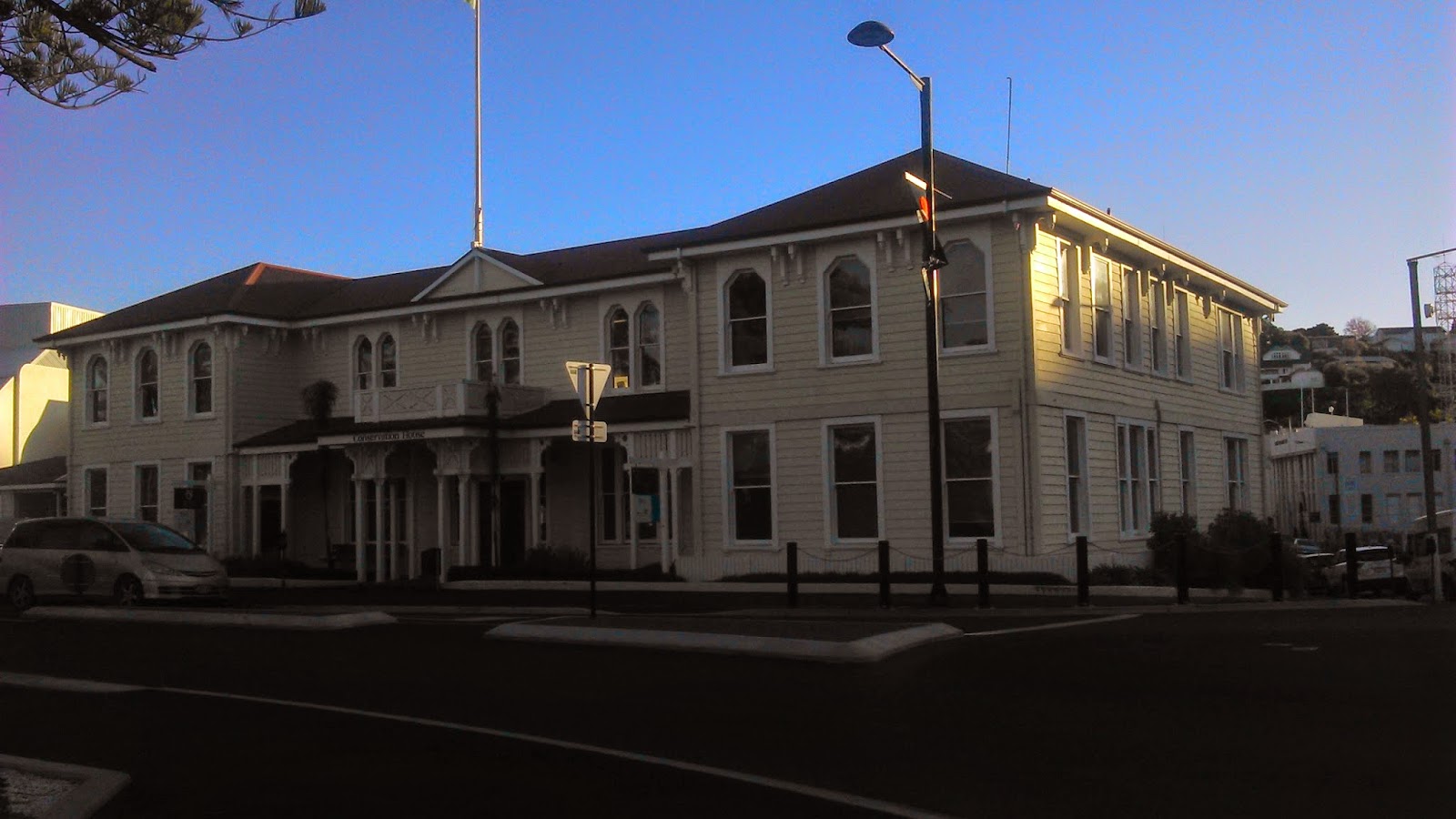
So it stands today, a concrete monument to the theme of 1920s & 1930s design. Nearly every building is in the Art Deco style. These are a couple of snaps I took, but you will find many more (and much better) by Googling for Napier and Art Deco


New Zealand's National Aquarium

Glass tanks filled with dark water aren't the best for photography, so I'll try give you a brief round up about the aquatic life I saw.

Due to the conservation work that goes on in NZ any native animals seen in captivity generally are in some way compromised for handling the dangers of the uncivilized world. This can be due to injuries from dogs, fishermen, hunters, or cars, as well as many other sources. Alternatively they may have been hand reared and so not have the skills to go wild. And so this sad turn of events is why the penguins all have missing parts.


There was also this beauty, a large sea turtle, with a shell the size of a fat man's torso.

There were also 8ft eels, 2ft cray fish, sharks, rays, star fish, angel fish, piranhas, conga eels, and lung fish.

There were also Tuataras, a form of endangered lizard only found in New Zealand. They are "living fossils" looking very much like lizard fossils found dating from a time before the dinosaurs. They are primitive, but how much they are truly a like to those ancient ancestors is something of a debate. Surely in some way they adapted to island life? How much has that changed them compared to those original lizards? One of the things I find fascinating is their ability, as adults, to change size. In times of drought they can reduce their size (right down to the size of their bones) by 20%, enabling them to survive on a reduced diet, before regrowing in better times.

There was also a Kiwi! Hidden in a dark room, behind sound proof glass, the fluffy football wandered round on cautious legs slowly sticking its nose in the leaf litter hunting for grubs. QI fans will remember that Kiwis have, scientifically, the shortest beak of any bird. This is because the science community measures beaks from the nostrils to the tip. Kiwis' have their nostrils at the tip of their "beak"such that they can shove it into things and hunt for insects by smell and sensing movement. It is some what unusual for a bird to have such a good sense of smell, most relying on their exceptional eyes, but Kiwis are nocturnal. Basically their an avian badger, without the TB, the screaming, or the ability to breed quickly. They run part of the breeding program from the Aquarium, hence this breeding female was on display there. Sorry, too dark for photos, but here's a nice chocolate Kiwi.


But my FAVOURITE animal goes to the RED GURNARD.

It WALKS! With 6 little tentacle-legs from near its gills it walks along the bottom of the sea/tank. It also has beautiful colouration on its pectoral fins, giving it the appearance of a butterfly.

Here's a link to a video of one walking: 
And some pics:

Also, outside the Aquarium, the nearby drains had these paintings around them proclaiming "Poison the Sea Poison Me!" Which looked amazing.


Now comes the part you've all be waiting for!

HM Prison Napier, wall and gate built in 1906 after the site had been used for a time as an army barracks.

In the 1800s the British Empire in NZ decided it needed somewhere to confine all the terrible people that happened to live in its borders. You know, the poor, the hungry, the mentally unstable, the newly arrived to this wee island. Those sort of terrible people.

So they built HM Napier Prison.

In its earliest days people were sent here for many reasons. There are letters from British relatives of people who were mentally unstable, asking to pay for their loved ones to be sent half way across the world to be kept under lock & key away from prying eyes. Others were here an immigrants, going through quarantine before being allowed into NZ proper. People were here because they were poor, as debtors. People could be sentenced to prison for only a few days if their crimes were minor, such as drunkenness and minor theft. 
And prison in those days was not as liberal as it has become today. No Human Rights act back then.
No Talking. No Laughing. No Singing. No Loud Noises. No Exercise.
3 to a 2-man cell. Doors shut at night, with only a 6 inch by 3 inch window for ventilation.
Doors open during the day, but no leaving your cell except for meal times.
Rations of bread and water, maybe more if you were doing hard labour.

These rules changed when prisoners started to get sick from malnutrition. 

Yet there were also, still, those people who they decided didn't deserve even these conditions.
A man who murdered his young children and wife after dreaming that they would die in a fire.
The man who took vengeance for the murder of his family by killing the murderer, then ate the eyes of his victim, as they contained the souls of his loved ones.
The pedophile who killed a young girl then evaded capture for decades. (he had to have his own exercise area, as otherwise the fellow inmates beat him.)

These terrible humans, and many more are buried in the small cemetery at the back of the prison. They are buried standing up, so that in death they can never have rest. Which would explain all the hauntings, and the including this sign being above the entrance to the area around the grave sight.


The Cultural Reasons are the belief that poltogeists formed by the spirits of the undead can possess the unborn and young children, living out their life once more, working to finish all that which they have not achieved in their own mortal life.

This has happened before, relatively recently.

A family came to the prison as tourists. After the visit the families young son started acting strangely, outside of his normal character. So, after 2 weeks, the family returned to the prison, with a priest, to exorcise the child, and he was back to normal there after. 

There are also stories of different people who stayed having dreams (or hallucinations) of a heavy weight on their chest, like someone sitting on them, and feeling a knife against their throat. Numerous times strange figures have been seen. The 8 foot dark figure that looked like a man walking one of the wings at night. The man who haunts the cell he spent his last night in prior to his execution on the anniversary of his death. (No one is allowed to stay in that room on that annual night any more.) Spheres of light that appear in photos taken inside the prison grounds. Spirits that a British traveller would sit on his bed and talk to every night. And the cat. Always the cat that appears near any of these supernatural occurrences.  The cat that has half a mustache, just like the last man to be executed at the prison.

Not only all of these stories, but inmates have left evidence of them in the mundane dimension too. The first cells I visited on the tour were those used for solitary confinement and for insane inmates. In side where all manner of messages and marks, including swastikas.

Three cells were designated "suicide watch", though this didn't stop many prisoners trying and managing to end their lives, using the easily exposed electrical wiring, or strangling themselves using springs from their beds. Their suicide notes are still visible, drawn or carved into the walls.

There are displays of gang art in a few cells. Prisoners from the 1950s onwards would write and draw on the sheets of MDF that made up their beds, covering the art with their mattresses. Gang signs are in abundance, as well as messages of hate. Many show the symbol of the "Mongrel Mob", a British bull dog wearing a Nazi SS helmet, often with a swastika. There had also been Black Power art, a black fist held in the Black Power- but this had been drawn over to create a pig's hoof. The Mongrel Mob seem to have made up the majority of inmates in the late 20th century, committing multiple horrific crimes both inside and outside prison.

I hope you can appreciate why I didn't feel like taking many pictures of the site. Prisons which once held the poor, the mad, and the hungry seem interesting and tame. In those days the worst of humanity was strung up as soon as they were convicted. Yet this prison carried on after those times, to hold those truly lost to society and civilisation. One just doesn't feel like ever remembering the efforts of  evil men when standing where they stood, reading what they thought, hearing what hate filled things they did. But that's no reason not to remember and hope that we can improve as a society. The gangs mentioned on the beds of inmates still exist today. They claim to have changed, improved, be working for their communities on charity projects and aid. I can't tell you if any of this is true, I can only hope it is.


The prison was closed in the 1980s, as the facilities grew substandard for the modern world. The prison was sold to private investors. Since then it has been used as a site for a local Alcoholics Anonymous group... until scary stuff happened. A hostel for backpackers wanting to stay in the cells and have spooky unhinging nights... until scary stuff happened (and many people have run screaming from their beds in the middle of the night). And now its a tourist destination. There are still people living here, staying a "minimum" of three months (if they last that long) working as tour guides and one the once a month late night scare show. A few of these have seen "ghosts" experienced strange goings on.

PS, for anyone wondering, during the 1931 Earthquake the prison, with most of the buildings made out of wood, fared very well. The floors are still buckled and broken after the event, which led to guards having to chop down walls as doors became jammed in the altered floor. These prisoners then helped in gangs to clear and rebuild the city. They also helped to build this wee park, from what was once a quarry they worked as part of their Hard Labour detail.


Finally I'll add some last few pictures of a few other places I went to.
Napier has a model railway museum! So just had to go there.
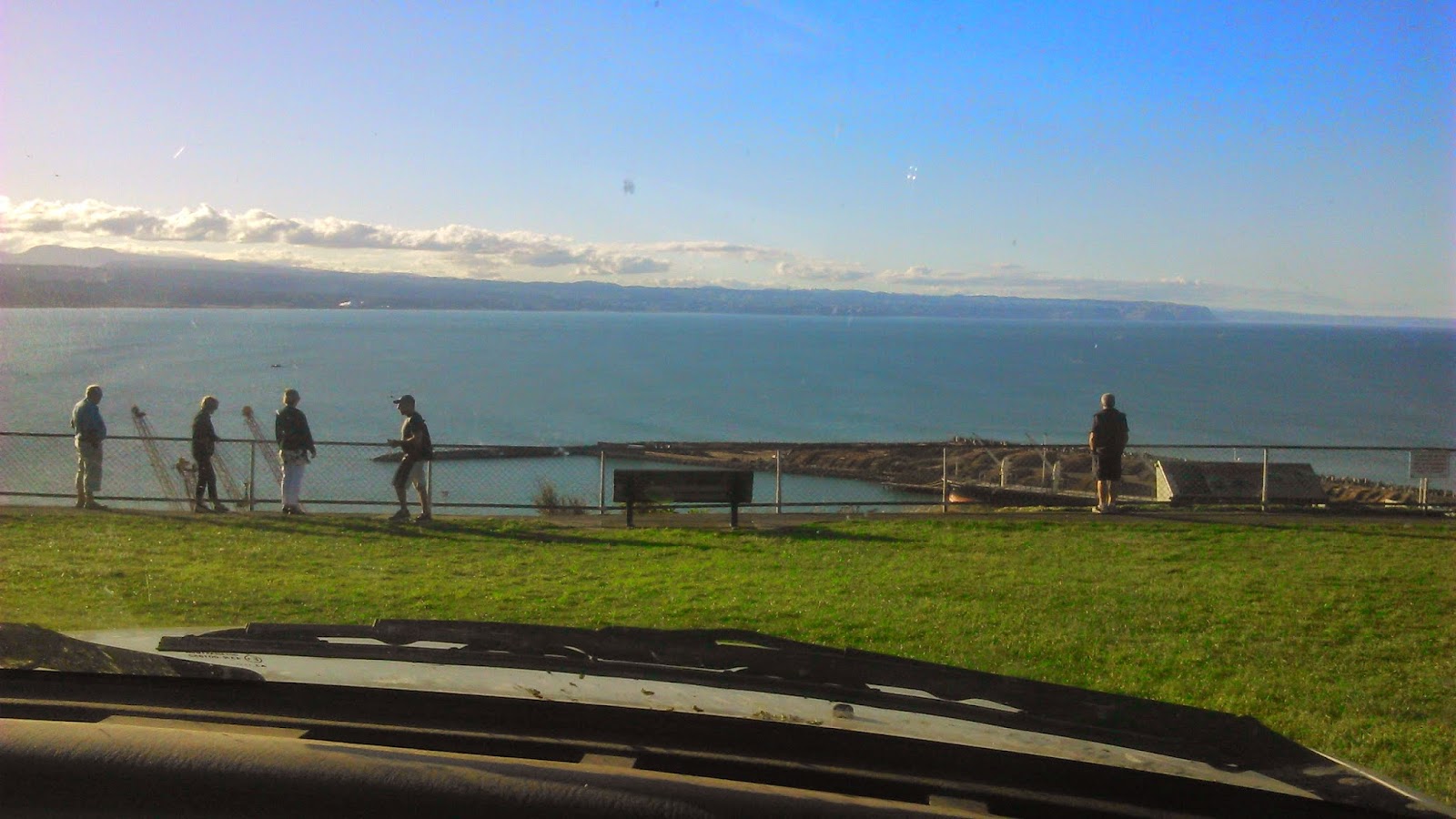
And Bluff Hill look out point, which was once housed 2 artillery pieces, and now lets tourists look over Hawke's Bay and the modern harbour.


Can you tell which one's are from the real life harbour?


A fountain funded by a Mr Parker


And Parker's Chambers

Both of which I'm sure my mother's side of the family (The Parkers) will find interesting  


I stayed in an old stable building, converted into a hostel